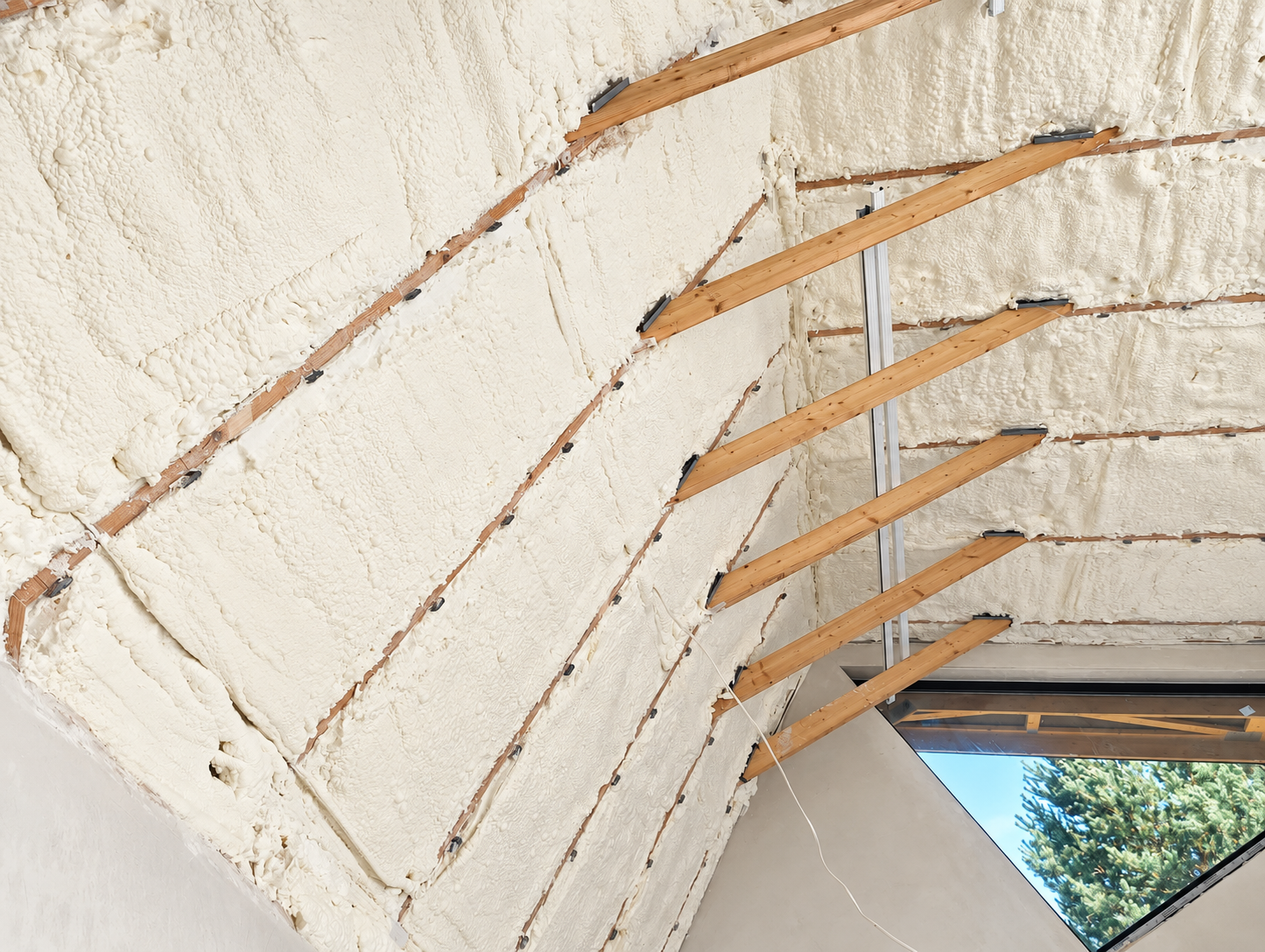


Katowice, Silesian Voivodeship. Scope: insulation of roof and wall sections in heat loss zones. Area approximately 620 m², insulation: closed-cell foam.
Katowice, Silesian Voivodeship. Warehouse in constant use, working area approximately 620 m². The work was performed by our silverFoam Certified Contractor.
In an industrial facility, insulation is only half the job. The other half is the schedule. A warehouse that stands for a week costs more than the thermal modernization itself, so the conversation with the investor begins not with the thickness of the layer, but with the question of which zones can not be used and when.


Illustrative photos.
Scope of work
Parameters
- Working area: About 620 m².
- Type of insulation: closed-cell silverFoam CC35 HFO foam.
- Specified layer thickness: 7 cm.
- Main scope: insulating selected roof and wall sections in the areas with the greatest heat loss.
Challenge: working in an operating facility
The scope did not cover the entire hall. The investor needed improvement where heat losses were the greatest and most noticeable to employees, not a comprehensive thermal modernization of the building.
This scope requires prior diagnosis. The contractor inspected the facility, determining the zones with the greatest losses, the condition of the substrate in each of them and access to work places with the existing system of racks and ceiling installations. On this basis, a division into stages was created, adapted to the rhythm of warehouse operation.
Work organisation
The hall was divided into zones, implemented sequentially, so that only one of them was excluded from use at a given time. The rest of the facility operated normally.
Each stage included securing ceiling installations, lighting, sprinklers, ventilation ducts and goods in the vicinity of the work zone. When spraying in a hall, aerosol mist spreads around the hall, and foam that settles on the casing of a lighting fixture or on a pallet with goods may be a problem that cannot be explained by the schedule.
Spraying was performed in layers, with the uniformity of growth controlled. Attention was paid to the joints of partitions, steel structure bypasses and service penetrations. In halls, columns, purlins and penetrations are the most crucial places where proper insulation must be performed.
After each stage, the surface was visually checked, critical parts were supplemented and the zone was returned for re-use.
Why use spray insulation in an industrial facility
The hall's structure is a dense mesh of elements: columns, bracing, purlins, cables. Insulating boards or mats require cutting around each of them, which, given this geometry, means hundreds of joints and the same number of places where thermal bridges may occur.
The foam covers these surfaces with a uniform layer, without mechanical fasteners piercing the insulation. In addition, there is the pace of work. In the case of this investment, the entire project took 5 days.
Outcome for the client
Zones with the highest heat losses received a continuous layer of insulation, routed through structure bypasses and service penetrations. The staging limited downtime to individual zones, without stopping the operation of the entire facility.
The investor received photographic documentation of the layers made and recommendations regarding subsequent zones that should be insulated in the next season.
Key points to remember
- In an active industrial facility, the schedule is part of the scope, not an addition to it. The division into zones is determined before the quotation.
- Piecewise insulation makes sense if it is preceded by identifying the zones with the highest actual heat losses.
- The steel structure of the hall has hundreds of places where the insulation made of boards or mats requires cutting. The spray application covers them without joints.
- Protecting overhead services and stored goods in a warehouse takes longer than the spraying itself.